March 2nd – The Potion

The Potion is a list poem. They are one of my favourite types of poem to read and write. This one was inspired by children’s bath time but they can be about absolutely anything!

Ian McMillan wrote one called ‘Ten Things Found in a Wizard’s Pocket’ and Colin West wrote one called ‘Socks’ – you should check it out – I bet you never knew there were so many types of sock!

Why not have a go at writing your own list poem? This can work well in the classroom as a starter activity with each child writing just one line to add to a shared poem.

How about ‘A List of Things I’ve Forgotten’ or ‘Times I’ve felt Scared’. You could write a poem called ‘Things I’d take to the Moon’ – I’d take some crackers to have with all that cheese.

For an extra challenge try using your list poem to tell a story – at the end of The Potion we can imagine bath time coming to an abrupt end. What will happen at the end of your poem?

March 1st – The Menu

I haven’t blogged for a while and, like most things, blogging is much easier when it becomes a habit. I habitually brush my teeth in the morning, drink tea with one sweetener and leave the house with all the children and paraphernalia with which they are associated. This is routine and so it gets done.

When I blogged for 100 days in a row about exercise it wasn’t a chore (nor, surprisingly, was the exercise!) but now my trainers are lost to the back of the downstairs cupboard along with a few broken toys and that coat I never really liked but pretended I did to be polite. My blogging momentum lies abandoned with them.

So I have set myself a challenge. Inspired by poet Brian Moses’ blog, found here, I have challenged myself to share a poem a day for the month of March, alongside some tips for how they might be used to inspire ideas for writing poetry. You can follow Brian Moses on twitter: @moses_brian

I wrote this poem after watching our children playing in a role play kitchen. They did not concern themselves with making the usual foods one might find on a cafe menu; they let their imaginations run wild!

Have a go at writing a food poem.

You could write a BOGUS BREAKFAST menu or a list of treats to be sold at the CEMETERY’S MIDNIGHT CAKE STALL – what would be on it?

Perhaps your poem will contrast delicious foods with grotesque descriptions – there is lots of fun to be had!

Think of unusual places food might be served. What about afternoon tea on the moon? What might be on the menu then?

If you want to share your poem with me I’d love to read it! You can email charliebownauthor@outlook.com or share your work via Twitter @CharlieDBown

Coming Soon!

When I started approaching agents and publishers last year I was prepared for the inevitable rejection emails. Everything I’d read about this process suggested it could (and most likely would) be a long journey to publication, if I ever got there at all.

So why not self publish?

When I decided to be a teacher I didn’t just rock up to a classroom and get on with it. I spent a year training and completed a PGCE, had my lessons observed and commented on, learnt what I was good at and what I needed to work on. I had a tutor and a mentor and by the end of the year I knew I was going to be good at my job.

How do I achieve the same validation within the world of writing? To me the answer seemed simple, find an expert in the industry and get them to love my books. I am not against self publishing at all and I have read lots of SP books which I’ve loved. But for me, I needed the reassurance that a professional in the industry agrees that my writing is worthy of being put into a book.

I still do need that external input. So for now my picture books and chapter books remain firmly unpublished and waiting for that magic agent or spectacular rewrite when I come back to them again later. But poetry, it turns out, is a different sort of ballgame.

So many agents and publishers have NO POETRY on their submissions guidelines. Why? Kids love poems! But this is a business game after all and a little poetry book by an unknown poet is not necessarily going to equal big sales numbers. When it comes to poetry there seems to be a much bigger no entry sign than any other type of text.

Three things have happened in the last few months.

Firstly, a friend in the music industry told me that when people approach him with songs the first thing he wants to know is who is this person and how committed are they? Is it one song or do they have more? The bottom line – why should he take the risk? Finally, he asked me if I had considered self publishing my poetry to show I’m committed to my own writing?

No. No, I hadn’t.

The second thing that happened was that I contacted a published poet. Someone relatively new in the industry, someone whose poems I’d read and enjoyed, someone who was where I wanted to be – visiting schools with his published poetry books and sharing them with children.

Do you have an agent? How did you get published? Please tell me your secrets!

He explained that his journey started as a self published poet. Once he’d spent a few years doing the school circuits and selling his books he approached a publisher and said, hey – look at me! I’m great at this. And he could prove it. He was selling books and that was a language the publisher was willing to take a chance on.

The third thing that happened is that it was National Poetry Day and I felt really sad. I felt sad that for another year I was looking at my poems in a file on my computer and wishing rather than doing. The theme of NPD this year was choice.

OK, Universe. You have my attention.

Because we do have a choice. A choice authors in the past didn’t have and perhaps that choice is also a chance, a chance to prove that you’re passionate and committed and most importantly, excited to share your writing with an audience.

And on that note, I hope to have some very exciting news to share with you soon…

My Nose

My nose doesn’t work. It never has. Around the age of seven (it took that long!) I realised that I had absolutely no idea what people were talking about when they mentioned ‘smells’. What were these strange things that I’d nodded along with and claimed to understand?

It turned out I had anosmia (no sense of smell). People who have experienced a bad cold might have lost their sense of smell for a few days but I have never had it. I get asked if it makes me feel sad – it doesn’t. I’ve never had it, so in turn I know not what I am missing.

I hear the best smells are freshly cut grass after rain and bread baking…

I’ll leave the worst smells to your imagination.

This poem was inspired by a talk on senses at the science museum we visited at the weekend.

My Nose Knows

My nose knows
So many different things
It knows when the 
Seasons change
And when Great Gran’s about to ring.

My nose knows who 
Will win the race
At Sport’s day
Before the teacher says Go.
It knows how it feels
To run so very slow.

My nose knows when laughter
Isn’t real or kind.
It gets all hot, a tiny fire
Burns through nostrils
To my mind.

My nose knows when
Someone feels so sad
That they want to sleep all day
Cocoon themselves in blankets
Hide away.

There’s only one thing
My nose knows not.
The one thing it’s supposed to.
The smell of bread and rain and grass.
The smell of dog poo on shoes
And flowery soap.
The smell of chocolate eggs and 
Mummy’s perfume
When she holds me tight.

These things my nose will never know.

Worrying

My last blog post was in May. May! Many months ago now. Shame-faced I returned to the WordPress log in screen and after several failed attempts had to accept that I no longer remembered my password to my own website. It’s been that long.

There are lots of reasons (excuses) for this tumble weed silence but perhaps the most prominent is worry. Some of it mine and some of it belonging to others. Our son started school this September. A joyful and exciting experience which was foreshadowed by sleepless nights and a wealth of worry as his four year old brain processed this step.

Of course, sleepless nights for children often mean sleepless nights for parents too and after a summer of sleeplessness the idea of being creative dwindled.

Or if not the idea (as the ideas kept coming to my sleep deprived brain) then certainly the ability to process and channel that idea into a creative output. Mostly I just ate toast.

And perhaps I let my own worries creep in too. I’ve been writing with the intention of being published for two years now – what if I’m just not good enough? What if I’m so worried about trying to get published I’m not making the time to sit down with new ideas? What if this whole pursuit is actually a bit embarrassing and I should just slink away now and pretend it was never something I wanted that much after all.

We talked to our son a lot this summer. We are a house which likes to talk. He knew he was nervous about school – he could tell us that it was the unknown that was the scariest part. I hear you buddy, I really do. Not knowing what will happen is scary. It’s scary sending your writing off into the world of experts and not knowing what (if anything) might come back.

With his best friend holding his hand our little one went into his new classroom for the first time a few weeks ago and bounced out three hours later with exclamations of “the best day ever”.

8 weeks of sleepless nights just melted away with a reminder that the worry is often the hardest bit. With that in mind, here’s a poem I’ve been working on. It’s time to put down the marmite toast and get working again.

Never Worry a Worry

Never worry a worry,
Or let a worry worry you.
For if a worry worries
then a worry can come true.

It’ll hide around a corner,
Sneak behind you on a walk,
It’ll creep and lurk and whisper,
’till ideas start to talk.

‘Oh dear, oh no, oh never!’
Will consume your every thought,
‘I really can’t. I won’t. I don’t,’
Will be just the very sort –

of things your brain will dwell on,
And stop you living life.
For a worried worry worries,
causing every kind of strife.

So if you feel a worry,
Bubbling away,
Don’t let your worry worry,
Embrace it for a day.

A worry’s just a thought,
That got lost along it’s lane.
So hug it, love it, talk to it,
And listen just the same.

For a worried worry worries
Because it’s all alone.
But a worry that is shared
Can change it’s worried tone.

If you have a worry,
Don’t keep it locked away.
Show your worry you will help it,
To stand and face the day.

Why do we do this to ourselves?

I don’t remember when I knew I wanted to be a writer. In truth there probably wasn’t a magical revelation moment. It was just something that was always there in the background ticking along. Over the years I’ve filled countless notebooks with stories, or bits of stories, or just words which sounded interesting. I’ve planned out novels, written articles and jotted down poems on scraps of paper. 

They all exist somewhere – most of them in boxes in the attic, along with the childhood treasures we couldn’t part with and at least three blow up air beds we forget about each time we have guests. More recently I have become organised and now much of my writing is stored in the Cloud: the magical land of word documents – less dusty than the attic at least. 

So although there was no ‘I’m going to be a writer’ moment, there was definitely an ‘I’m going to try and get published’ moment. It was the 1st January 2020 when I made my annual resolutions list and stuck it to the fridge. 

In that first month I wrote a picture book and, having done absolutely no research whatsoever, sent it off to literary agents in a frankly shocking display of naivety. I waited for the offers of representation and instead received silence (shock! horror!). This is the empty inbox equivalent of a tumbleweed rolling around and crushing my dreams. 

I know. I know. No one gets published the first time, right? Well. I mean, some people do. But they are the exception. And don’t worry – even JK got rejected at first. People are kind – too kind sometimes. What I probably should have been told back then, on that frosty January filled with hope and ambition, was that actually I didn’t deserve to get published. 

I had done no research. I hadn’t asked anyone to critique my writing. I hadn’t even bothered to learn how to present a picture book manuscript, or how many pages (which I now know are called spreads) are in a picture book. I had done none of the hard work which I now understand is required. Those silent rejections were not only appropriate, but fully deserved. 

I wish I could write that a year and a half later I have put in the hard work and now the magic has happened. Because I have worked hard. I’ve read and read and then read some more. I’ve entered competitions, started building up a writing community network, attended lectures and been on courses. I have two writing critique groups and I am learning more than I even knew I needed to learn. I have had so much valuable and varied experience which has in every way made me a better writer.

But I am still not a published one. 

The last fortnight started with such hopefulness. A Twitter pitch day (I didn’t even really understand Twitter last year), a poetry head-to-head competition and a completed YA novel sent to three prospective agents. But after an unsuccessful pitch day and being knocked out of the competition in round one, I am feeling decidedly less positive. 

Then the real blow came. 

I listened to an established author talking about writing compelling plots last week. Her latest book was just about to be released and the talk was in part to promote her novel. It worked. I purchased it immediately and it arrived two days ago. I finished it today. It was brilliant. I loved it. The only trouble was – a major plot point was identical to the one in my novel. I don’t mean they were a bit similar – I mean they were spookily, eerily, terrifyingly similar. Some of the lines were almost word-for-word matches. It was very disconcerting reading it and part of my heart broke that my novel has already been published but it wasn’t me who’d written it. 

I suppose this must happen all the time. As is often said, there aren’t an infinite number of plots. Just the same stories told in different ways. But even so, I still can’t quite believe it. I remain positive that at least the idea must be a good one, good enough to get published. Even if someone else did get there first.

So, why do we do this to ourselves? I honestly feel like throwing in the towel (or the writing equivalent – recycling the paper?) and calling it a day. Perhaps, like the number of plots, there isn’t an infinite number of times you can be told you’re not good enough before you quit. 

But then this happens…

A new idea.

A new story I want to write.

A new story I have to write.

And then we’re off. Step one (again) on the merry-go-round of life as a wanna-be-author. Maybe this book will be the one which gets published. Maybe it won’t. But at the end of the day it’s not actually about the rejections or the acceptances (one day, please!) – it’s because the stories are there and they need to be written. 

Eggbert

What happens when you’re in the wrong place at the right time? The right time is now – Valentines’ Day! But the place Eggbert finds himself is the early Easter shelf, not the one covered with pink hearts and roses. How will he find his valentine now? With the stealth of an egg but the heart of a bear, Eggbert will have to be BRAVE.

Bravery is the theme for this short (very short – only 214 words) story competition I entered to write a valentine story for children. If you’ve never written to such a short and specific word count, I would highly recommend it. Mini word counts really make you hone in on what you want to say, as well as ensuring that you pace your story well. It’s no good spending 200 words introducing your character and their situation only to be left with 14 to finish the job!

The link to the competition is HERE if you would like to read the other entries but for now, let me introduce….

EGGBERT

Eggbert was in the wrong place. He was meant to be on the red shelf with the hearts but had somehow ended up here, with the early Easter eggs. Perhaps someone was having a joke he’d thought, watching all the other teddies line themselves up ready to be chosen by loved-up customers. 

Then Eggbert saw his valentine – bouncing up and down in the trolley, smiling and pointing at him.

“That’s for Easter,” the little person’s big person said, “It’s too early for Easter!”

Eggbert’s heart sank into his fluffy feet. As his little person rounded the corner, Eggbert heard him howl with sadness and Eggbert knew what he had to do. 

As he moved, the Easter chicks below chirped with horror – “You can’t leave the shelf! It’s too dangerous!” But Eggbert was determined; he knew where he belonged. 

Teddies are not natural ninjas, especially ones as round as Eggbert, but that day Eggbert was fired up with love as he jumped over pineapples, raced along toilet paper, dived through cheese and finally caught up with his valentine at the till. With the stealth of an egg and the heart of a bear, Eggbert rolled into the trolley, straight into the arms of his valentine, who giggled and cooed, cuddling him all the way home. 

To Tweet or not to Tweet

After months of ignoring the very obvious hints, signs, massive blaring fog-horns shouting at me to join Twitter, I have finally given in and joined.

As an aspiring writer I’ve trawled the internet and read countless books about writing which, after talking about passion and creativity and you know – actually WRITING THINGS – all mention the world of social media. 

In 2021 we are fully immersed in the age of social media, and have been for some time. Yet I am still living in the deep, dark internet world circa 2008. I have a Facebook account which, after clearing the friends section of ‘random people I met once on the bus’ back in my student days, I have a few hundred people I’ve actually met, or worked with, or like. It’s mostly an online photo album now and occasional stalking forum. 

Other than Facebook I don’t have instagram, barely understand the concept of a tik-tok and have avoided becoming embroiled in twitter until yesterday. Why? I suppose fear of the unknown played a part. Perhaps I was worried about having yet another thing to keep me on my phone, another endless scrolling black hole of strangers. I just wasn’t sure I had the energy for it. 

Then this happened:

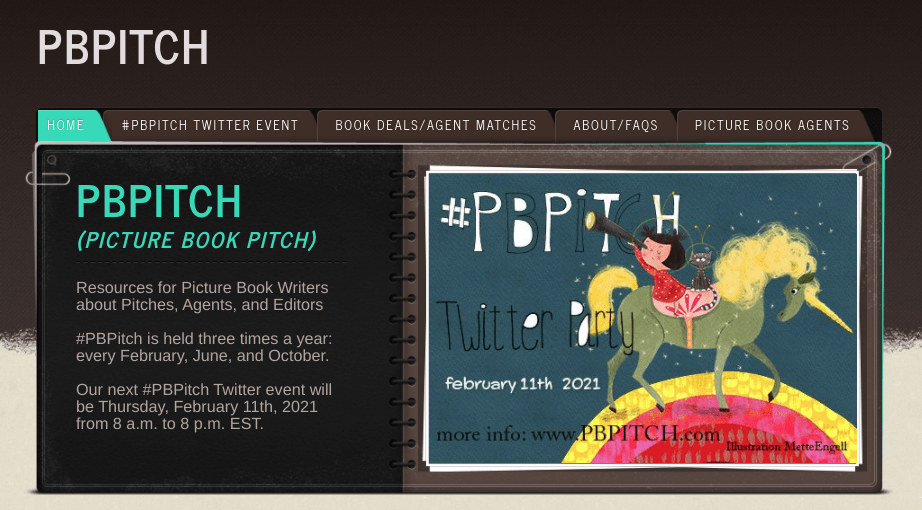
And I really, really, really wanted to be a part of it. The catch – you can’t take part in a Twitter Picture Book Pitch, without, well – being on Twitter. 

So I signed up and thought to myself,  I could always have a go at this whole #PBPitch thing and if it’s a massive flop then I will just quietly sneak away and press ‘delete account’. No-one will ever have to know…

It’s been 24 hours and I am, of course, completely obsessed. It had never occurred to me how instantly the world of #childrensauthors would open up to me, with very little effort on my part. My homepage/thread/newsfeed (I’m not sure I’ve got at the Twitter-friendly vocab yet) is flooded with other children’s authors – ones like me, starting on their journeys, others who are publishing for the first time this year, right up to famous authors. 

I now have access to their tweets, their thoughts, their world. And it’s not just authors – I am also following literary agents and publishers and editors. Of course, it doesn’t actually make me any closer to being published but it makes me feel like I’m a little bit closer to the playground I want to play in. It’s a community of people who are interested in, and talking about, writing for children and that is a very exciting group of which to be a part. 

Of course, now I’m blogging about tweeting and tweeting about blogging – it would be very easy to get caught up in the moment and forget why I’m actually here. Between the tweets and the blog and the website and finding my feet on social media, I must remember to make time to actually be creative, to write. Despite my initial fears, I feel energised by this new-found platform, excited to share my ideas and find my wings in this new world. 

@CharlieBown7

Filth

The mud cannot be avoided. It has been raining on-off for weeks now and all our favourite walks currently require a full outfit change (and sometimes even a shower) upon our return home.

One of the undeniably joyful things about being a parent is the fact that it is once more socially acceptable to jump in puddles and slide around in mud. Why we stop doing that as we grow up is beyond me. It’s good for the soul, if not the washing machine.

This poem was inspired by our children and their love of mud.

FILTH

Oozy, squoozy, slimy, stinky, squishy, squashy,
Mud.
On my hands and arms and face and gluing my hair together.
It’s my favourite game.
Digging, filling, pouring, mixing, splatting, slopping,
Mud. 
Mum joins in. She makes mud concrete for construction toys to move.
My little sister pulls funny faces 
But even she loves stamping, stomping, squelching, squashing
Mud.
Then dad looks at us and his eyes go wide,
popping, bulging, straining, craning, staring at all the
Filth.