A blank piece of paper – depending on your feelings about generating new ideas for writing – can be either the most daunting or most exciting starting point for a writer.
Let’s assume for a minute it’s the most daunting. The panic of having to put something on the paper and the possibility that what you do eventually put down might be absolute rubbish is generally the reason this bit is scary – not to mention the now mounting pressure on your creative mind to come up with something, anything, because now it’s been an hour and there’s absolutely NOTHING on the paper. How will I ever be a writer when I can’t even think of the first word?
Luckily I am still very much in the ideas stage – there’s no pressure on me to come up with a new idea to meet a deadline or prove I’m not a one-trick pony. Right now I’m still looking for the first trick so I get to enjoy this bit – the ideas bit.
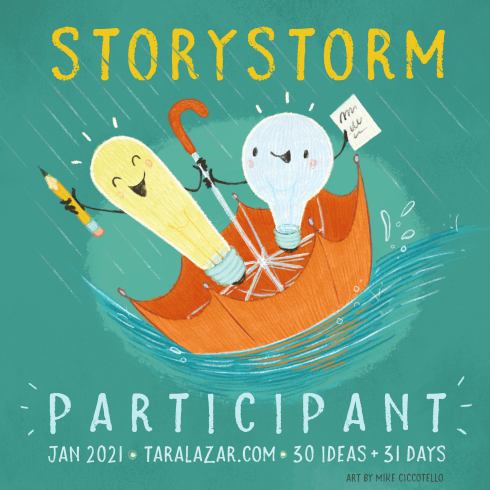
At the moment I am taking part in an online creative exercise called Story Storm:
Each day in January an author writes a blog post about where they go for their inspiration, how they generate ideas, where creativity stems from for them. I am 17 days in and it’s been fascinating to read and certainly inspiring to have a constant stream of ways to generate ideas trickling into my inbox.
Guess what – there is no right or wrong way to be creative. We are all capable of creativity, some of us are interested in harnessing it and taming it into some form of hobby or career, others are happy being creative as and when it is needed (my Dad is very creative with his use of duct tape to solve any household problem he comes across…)
When I teach creative writing in schools, the generating ideas part, the blank page, is often as daunting for children as it is for adults. I want children to love creating stories and to be excited about writing down their ideas – they certainly are not shy when they are first learning to tell stories. The number of stories about dragon poo I’ve listened to our four year old enthusiastically deliver could stretch to a ten part series. But once children are sitting down in a classroom with that blank piece of paper their insecurities and worries can start to block their creativity.
So how do we engage children with writing? I don’t mean the classic story mountain planning sheet or the basics of sentence structure and correct grammar. Those things are important in their own way, of course, but how do we harness that inbuilt creativity children demonstrate all the time in their play, without accidentally instilling in them the fear of a blank page?
We must be silly. We must be playful. We must be active.
And we must never be afraid of demonstrating our own creativity and thought processes when it comes to writing. Show them a blank page and show them that there’s nothing to be afraid of. One of my favourite activities in the classroom with younger writers was to ask them to shout out the first word which popped into their heads – even if that meant saying the name of something they could see in the room, or their own name, there was no wrong answer. Then bung some of them up on the board and start filling in your own blank page.
Now our page isn’t blank anymore and we can start generating ideas. Let’s imagine the words on the board are DINOSAUR, TOILET (There’s always one kid who says toilet…), CHAIR, LIGHT, SANDWICH – I might say something like this,
Wow! This is a brilliant story you’ve written. Look – There’s a dinosaur who eats chairs. He loves eating chairs so much that soon no-one has anywhere to sit. You’ll never guess what – everyone has to sit on the lights instead. Well, hang off them really. All the children hang off the lights at lunchtime trying to eat their sandwiches. When the dinosaur runs out of chairs to eat in the school he starts looking for other places people sit down. Uhoh, you got it – he starts eating all the toilets!
OK, it’s not Shakespeare but if done well it should have the desired effect of relaxing the anxieties around generating ideas and normally has the children in fits of giggles. As they get used to the idea, they start coming up with their own story ideas for the words they’ve generated on the board.
So what did we learn? It’s okay to be silly and make up ‘a load of rubbish’ because writing should be fun and silly and some of the best authors for children tap into this world and capture children’s imaginations by doing exactly that. So go now and write it – write some rubbish down on a blank piece of paper and then have fun trying to turn it into something silly.


 Charlie Bown