Day 10 – My Stick (By Sasha Kuntz)

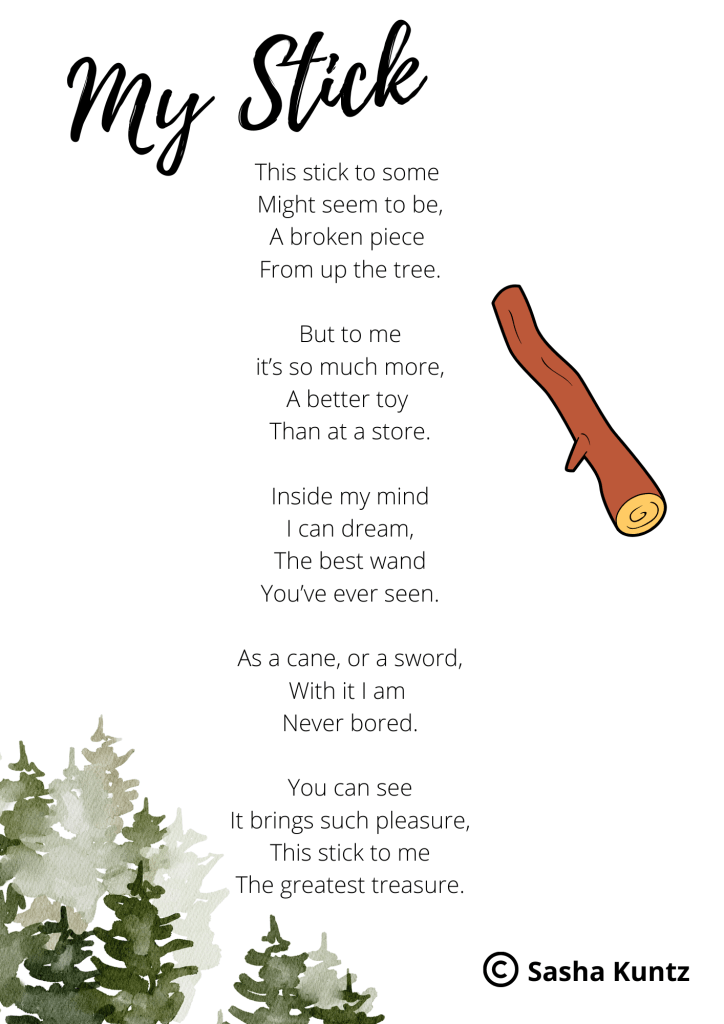
Today is a little bit different because instead of one of my poems, I am sharing writing from another author who has been in touch. I am delighted to share Sasha’s poem, ‘My Stick’, which was inspired by the ‘Treasure’ prompt from my Day 7 post.

One of the wonderful things I’ve noticed since reaching out to the writing community via Facebook and Twitter, is how wonderfully supportive they are of one another. It is certainly one of the happier parts of the internet and it is a pleasure to pass on some of that writing support to another poet today.

It can be really scary to share your writing with people, especially a stranger! So thank you to Sasha for getting in touch and for your fab poem:

March 9th – Earwig

I wrote this poem when our son misheard the word ‘earache’ and refused to believe me when I said it wasn’t ‘earwig’. Combined with his mispronunciation of the word ‘antibiotics’ it was a poem waiting to happen.

(It’s also true that my mum used to say that we should wear our hats to avoid earache – I have no idea if that is medically sound advice, or just something parents say – like watching too much television makes your eyes go square.)

Children often mispronounce words. Did you mispronounce any when you were younger? My little brother said ‘Heliplopter’ instead of ‘Helicopter’ which we like to remind him sometimes now he’s a grown up doing grown up things.

One of the things I love about writing children’s poetry is the fun that is to be found when playing with words and language. Children do this naturally as they are learning to speak. Have a go at writing a poem with some mispronounced or misused words and see what you can come up with.

Remember, you can always email me any poems – I’d love to see them and share them on here!

charliebownauthor@outlook.com

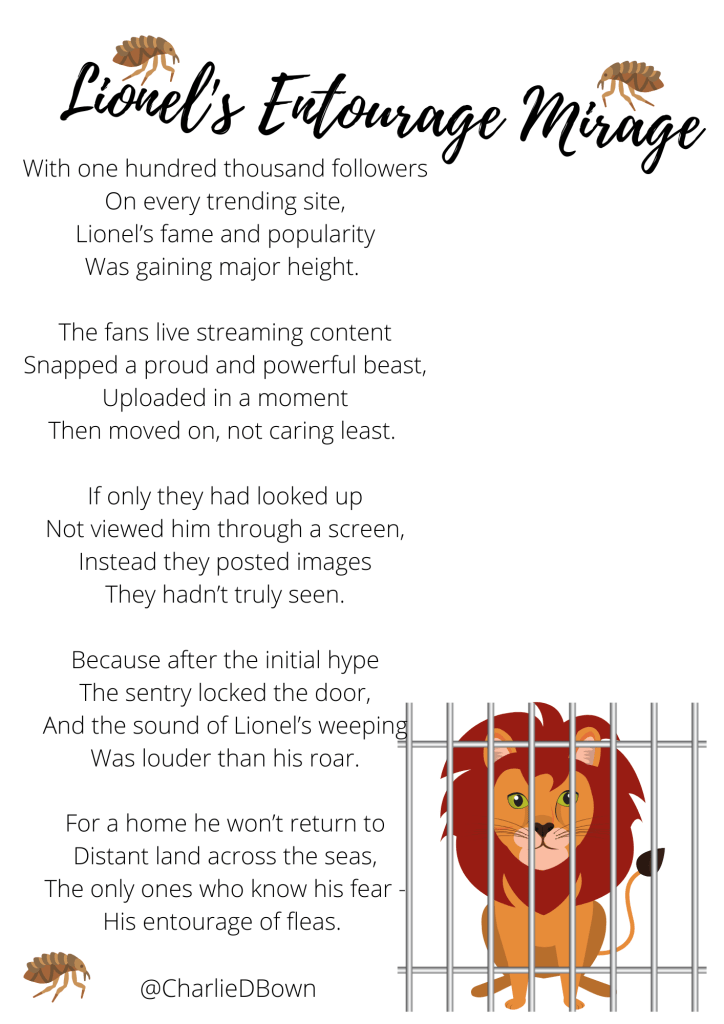
March 7th – Lionel’s Entourage Mirage

I wrote this poem as part of a competition, using a word prompt. The word I was given was ‘entourage’.

The first thing I did was read a definition of the word:

ENTOURAGE
noun

  1. a group of people attending or surrounding an important person. “an entourage of loyal courtiers”

Then I created a mind-map around the definition, taking each part in turn.

‘A group of people’ – what if they weren’t people? Who else might they be?

‘surrounding’ – for what reason? Could it be sinister? Funny? How close could they get?

‘an important person’ – Why is the person (or animal) important? Are they only important to the entourage?

I then thought about what entourage meant to me. It meant celebrity culture – adoring fans surrounding a popular singer or actor.

All these questions and thoughts helped me get to the stage where I had the idea for this poem.

‘A group of people’ (fleas) ‘surrounding’ (living on) ‘an important person’ (Lionel). Poor Lionel, who has adoring fans by day who take photos and upload them to social media, but is left alone at night with his real entourage – his fleas.

A writing prompt can be a fun way into a poem – especially if you take the time to really think about all the different ways that word could be interpreted. Have a go with one of the following words:

adopted

treasure

disaster

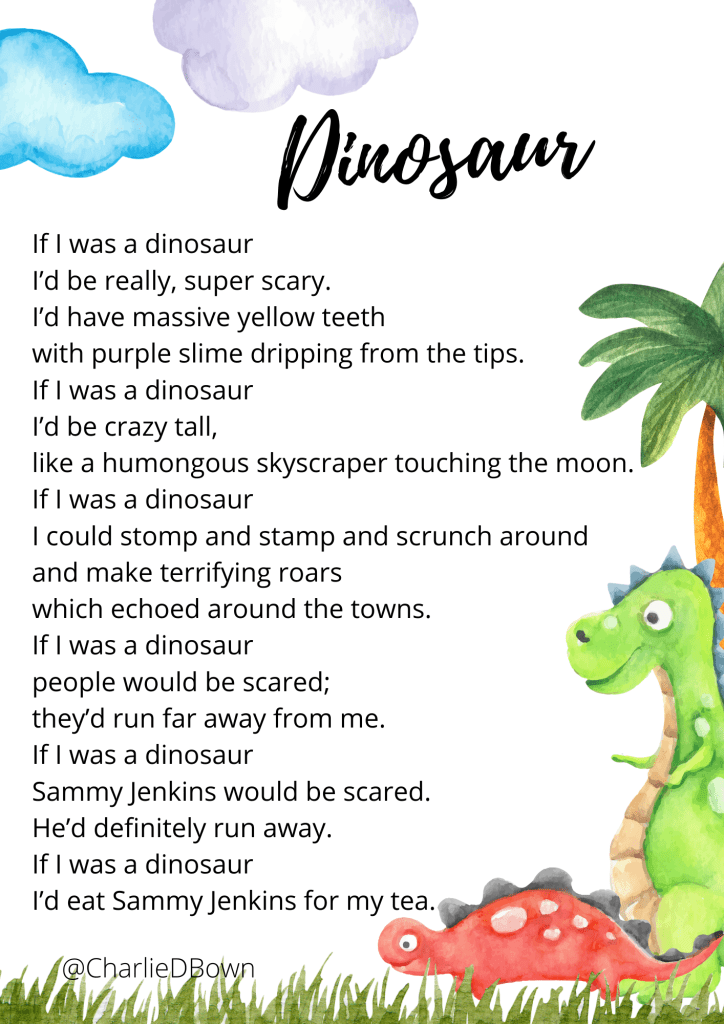
March 4th – Dinosaur

Depending on how confident children feel with drama activities, this activity can be done in a group or as individuals.

If working in a group ask children to choose an animal – living, extinct or fictional. Working together they have to create the animal using their bodies, working together to move around the space. Once they feel confident moving as a team encourage them to add sound effects, then give them different challenges to act out. How would your animal eat? Sleep? Interact with other animals in the room?

Once you’ve had fun exploring the animals, create word banks using the drama to guide you. To extend the activity think about what the animal might represent (Lions = bravery, Foxes = sly etc) can you add those characteristics into the poem? What happens if you reverse them – write a poem about a shy lion or a kind fox.

Use “If I were a…” as the poem’s starting prompt.

March 2nd – The Potion

The Potion is a list poem. They are one of my favourite types of poem to read and write. This one was inspired by children’s bath time but they can be about absolutely anything!

Ian McMillan wrote one called ‘Ten Things Found in a Wizard’s Pocket’ and Colin West wrote one called ‘Socks’ – you should check it out – I bet you never knew there were so many types of sock!

Why not have a go at writing your own list poem? This can work well in the classroom as a starter activity with each child writing just one line to add to a shared poem.

How about ‘A List of Things I’ve Forgotten’ or ‘Times I’ve felt Scared’. You could write a poem called ‘Things I’d take to the Moon’ – I’d take some crackers to have with all that cheese.

For an extra challenge try using your list poem to tell a story – at the end of The Potion we can imagine bath time coming to an abrupt end. What will happen at the end of your poem?

My Nose

My nose doesn’t work. It never has. Around the age of seven (it took that long!) I realised that I had absolutely no idea what people were talking about when they mentioned ‘smells’. What were these strange things that I’d nodded along with and claimed to understand?

It turned out I had anosmia (no sense of smell). People who have experienced a bad cold might have lost their sense of smell for a few days but I have never had it. I get asked if it makes me feel sad – it doesn’t. I’ve never had it, so in turn I know not what I am missing.

I hear the best smells are freshly cut grass after rain and bread baking…

I’ll leave the worst smells to your imagination.

This poem was inspired by a talk on senses at the science museum we visited at the weekend.

My Nose Knows

My nose knows
So many different things
It knows when the 
Seasons change
And when Great Gran’s about to ring.

My nose knows who 
Will win the race
At Sport’s day
Before the teacher says Go.
It knows how it feels
To run so very slow.

My nose knows when laughter
Isn’t real or kind.
It gets all hot, a tiny fire
Burns through nostrils
To my mind.

My nose knows when
Someone feels so sad
That they want to sleep all day
Cocoon themselves in blankets
Hide away.

There’s only one thing
My nose knows not.
The one thing it’s supposed to.
The smell of bread and rain and grass.
The smell of dog poo on shoes
And flowery soap.
The smell of chocolate eggs and 
Mummy’s perfume
When she holds me tight.

These things my nose will never know.

Worrying

My last blog post was in May. May! Many months ago now. Shame-faced I returned to the WordPress log in screen and after several failed attempts had to accept that I no longer remembered my password to my own website. It’s been that long.

There are lots of reasons (excuses) for this tumble weed silence but perhaps the most prominent is worry. Some of it mine and some of it belonging to others. Our son started school this September. A joyful and exciting experience which was foreshadowed by sleepless nights and a wealth of worry as his four year old brain processed this step.

Of course, sleepless nights for children often mean sleepless nights for parents too and after a summer of sleeplessness the idea of being creative dwindled.

Or if not the idea (as the ideas kept coming to my sleep deprived brain) then certainly the ability to process and channel that idea into a creative output. Mostly I just ate toast.

And perhaps I let my own worries creep in too. I’ve been writing with the intention of being published for two years now – what if I’m just not good enough? What if I’m so worried about trying to get published I’m not making the time to sit down with new ideas? What if this whole pursuit is actually a bit embarrassing and I should just slink away now and pretend it was never something I wanted that much after all.

We talked to our son a lot this summer. We are a house which likes to talk. He knew he was nervous about school – he could tell us that it was the unknown that was the scariest part. I hear you buddy, I really do. Not knowing what will happen is scary. It’s scary sending your writing off into the world of experts and not knowing what (if anything) might come back.

With his best friend holding his hand our little one went into his new classroom for the first time a few weeks ago and bounced out three hours later with exclamations of “the best day ever”.

8 weeks of sleepless nights just melted away with a reminder that the worry is often the hardest bit. With that in mind, here’s a poem I’ve been working on. It’s time to put down the marmite toast and get working again.

Never Worry a Worry

Never worry a worry,
Or let a worry worry you.
For if a worry worries
then a worry can come true.

It’ll hide around a corner,
Sneak behind you on a walk,
It’ll creep and lurk and whisper,
’till ideas start to talk.

‘Oh dear, oh no, oh never!’
Will consume your every thought,
‘I really can’t. I won’t. I don’t,’
Will be just the very sort –

of things your brain will dwell on,
And stop you living life.
For a worried worry worries,
causing every kind of strife.

So if you feel a worry,
Bubbling away,
Don’t let your worry worry,
Embrace it for a day.

A worry’s just a thought,
That got lost along it’s lane.
So hug it, love it, talk to it,
And listen just the same.

For a worried worry worries
Because it’s all alone.
But a worry that is shared
Can change it’s worried tone.

If you have a worry,
Don’t keep it locked away.
Show your worry you will help it,
To stand and face the day.

Why do we do this to ourselves?

I don’t remember when I knew I wanted to be a writer. In truth there probably wasn’t a magical revelation moment. It was just something that was always there in the background ticking along. Over the years I’ve filled countless notebooks with stories, or bits of stories, or just words which sounded interesting. I’ve planned out novels, written articles and jotted down poems on scraps of paper. 

They all exist somewhere – most of them in boxes in the attic, along with the childhood treasures we couldn’t part with and at least three blow up air beds we forget about each time we have guests. More recently I have become organised and now much of my writing is stored in the Cloud: the magical land of word documents – less dusty than the attic at least. 

So although there was no ‘I’m going to be a writer’ moment, there was definitely an ‘I’m going to try and get published’ moment. It was the 1st January 2020 when I made my annual resolutions list and stuck it to the fridge. 

In that first month I wrote a picture book and, having done absolutely no research whatsoever, sent it off to literary agents in a frankly shocking display of naivety. I waited for the offers of representation and instead received silence (shock! horror!). This is the empty inbox equivalent of a tumbleweed rolling around and crushing my dreams. 

I know. I know. No one gets published the first time, right? Well. I mean, some people do. But they are the exception. And don’t worry – even JK got rejected at first. People are kind – too kind sometimes. What I probably should have been told back then, on that frosty January filled with hope and ambition, was that actually I didn’t deserve to get published. 

I had done no research. I hadn’t asked anyone to critique my writing. I hadn’t even bothered to learn how to present a picture book manuscript, or how many pages (which I now know are called spreads) are in a picture book. I had done none of the hard work which I now understand is required. Those silent rejections were not only appropriate, but fully deserved. 

I wish I could write that a year and a half later I have put in the hard work and now the magic has happened. Because I have worked hard. I’ve read and read and then read some more. I’ve entered competitions, started building up a writing community network, attended lectures and been on courses. I have two writing critique groups and I am learning more than I even knew I needed to learn. I have had so much valuable and varied experience which has in every way made me a better writer.

But I am still not a published one. 

The last fortnight started with such hopefulness. A Twitter pitch day (I didn’t even really understand Twitter last year), a poetry head-to-head competition and a completed YA novel sent to three prospective agents. But after an unsuccessful pitch day and being knocked out of the competition in round one, I am feeling decidedly less positive. 

Then the real blow came. 

I listened to an established author talking about writing compelling plots last week. Her latest book was just about to be released and the talk was in part to promote her novel. It worked. I purchased it immediately and it arrived two days ago. I finished it today. It was brilliant. I loved it. The only trouble was – a major plot point was identical to the one in my novel. I don’t mean they were a bit similar – I mean they were spookily, eerily, terrifyingly similar. Some of the lines were almost word-for-word matches. It was very disconcerting reading it and part of my heart broke that my novel has already been published but it wasn’t me who’d written it. 

I suppose this must happen all the time. As is often said, there aren’t an infinite number of plots. Just the same stories told in different ways. But even so, I still can’t quite believe it. I remain positive that at least the idea must be a good one, good enough to get published. Even if someone else did get there first.

So, why do we do this to ourselves? I honestly feel like throwing in the towel (or the writing equivalent – recycling the paper?) and calling it a day. Perhaps, like the number of plots, there isn’t an infinite number of times you can be told you’re not good enough before you quit. 

But then this happens…

A new idea.

A new story I want to write.

A new story I have to write.

And then we’re off. Step one (again) on the merry-go-round of life as a wanna-be-author. Maybe this book will be the one which gets published. Maybe it won’t. But at the end of the day it’s not actually about the rejections or the acceptances (one day, please!) – it’s because the stories are there and they need to be written. 
Finding Pace

Last night I was sat poring over another draft of a picture book text I have been working on for over a year now. Yep, you heard right. A picture book text of less than 800 words and here I am a year later, still working on it. It’s one of my favourite story ideas but something has been sticking, niggling away at the back of my mind, keeping me awake at 4am as I try to work out what it is. Then last night, I got it.

We were listening to the music of a friend of ours. His new album arrived on Spotify yesterday (you can listen here) and after dinner, kids in bed, tea poured, we sat down to listen. My first thought was this: I don’t listen to enough classical music. It was truly beautiful and wonderfully calming.

A memory of secondary school music lessons popped into my head (quite impressive as my memory is genuinely pretty awful) – when we would sit listening to music and the teacher would ask us to think about the pace of the music and the impact it had on us as it changed.

As the music I was listening to continued, I tried to apply this technique. How did I feel? Which images did it conjure? How did the pace of the music change those images?

And then my picture book suddenly made sense. I’d been re-writing the words, sometimes in rhyme, sometimes in prose, for a year now. New words, different words, the same words in different orders. But the one thing I had been ignoring was the pace of the story.

It seems so obvious now, re-reading the most recent draft. It’s a good story but the pace doesn’t match the action. It’s a fast paced story, with non-stop action but the language was too flowery, too detailed, too slow. I had to ramp up the pace, create more tension, keep the flow of the story going – and then bring the pace back in as the story concluded.

I needed to write the story like a piece of music – preferably like the Benny Hill theme song, that level of bounce and bumble.

When I asked my husband to re-read the story (draft 1 million and 4…) his first comment afterwards was that I’d cut down the word count. I hadn’t. The word count was exactly the same as the previous version he’d read but he’d read this version with increased energy and speed thanks to the change in pace.

It’s so easy to get caught up in the words we put down – the notes of the story – but I am so grateful for the reminder to write with pace in mind and to craft a story like a piece of music, taking the reader on a journey as you write.