My Nose

My nose doesn’t work. It never has. Around the age of seven (it took that long!) I realised that I had absolutely no idea what people were talking about when they mentioned ‘smells’. What were these strange things that I’d nodded along with and claimed to understand?

It turned out I had anosmia (no sense of smell). People who have experienced a bad cold might have lost their sense of smell for a few days but I have never had it. I get asked if it makes me feel sad – it doesn’t. I’ve never had it, so in turn I know not what I am missing.

I hear the best smells are freshly cut grass after rain and bread baking…

I’ll leave the worst smells to your imagination.

This poem was inspired by a talk on senses at the science museum we visited at the weekend.

My Nose Knows

My nose knows
So many different things
It knows when the 
Seasons change
And when Great Gran’s about to ring.

My nose knows who 
Will win the race
At Sport’s day
Before the teacher says Go.
It knows how it feels
To run so very slow.

My nose knows when laughter
Isn’t real or kind.
It gets all hot, a tiny fire
Burns through nostrils
To my mind.

My nose knows when
Someone feels so sad
That they want to sleep all day
Cocoon themselves in blankets
Hide away.

There’s only one thing
My nose knows not.
The one thing it’s supposed to.
The smell of bread and rain and grass.
The smell of dog poo on shoes
And flowery soap.
The smell of chocolate eggs and 
Mummy’s perfume
When she holds me tight.

These things my nose will never know.
Worrying

My last blog post was in May. May! Many months ago now. Shame-faced I returned to the WordPress log in screen and after several failed attempts had to accept that I no longer remembered my password to my own website. It’s been that long.

There are lots of reasons (excuses) for this tumble weed silence but perhaps the most prominent is worry. Some of it mine and some of it belonging to others. Our son started school this September. A joyful and exciting experience which was foreshadowed by sleepless nights and a wealth of worry as his four year old brain processed this step.

Of course, sleepless nights for children often mean sleepless nights for parents too and after a summer of sleeplessness the idea of being creative dwindled.

Or if not the idea (as the ideas kept coming to my sleep deprived brain) then certainly the ability to process and channel that idea into a creative output. Mostly I just ate toast.

And perhaps I let my own worries creep in too. I’ve been writing with the intention of being published for two years now – what if I’m just not good enough? What if I’m so worried about trying to get published I’m not making the time to sit down with new ideas? What if this whole pursuit is actually a bit embarrassing and I should just slink away now and pretend it was never something I wanted that much after all.

We talked to our son a lot this summer. We are a house which likes to talk. He knew he was nervous about school – he could tell us that it was the unknown that was the scariest part. I hear you buddy, I really do. Not knowing what will happen is scary. It’s scary sending your writing off into the world of experts and not knowing what (if anything) might come back.

With his best friend holding his hand our little one went into his new classroom for the first time a few weeks ago and bounced out three hours later with exclamations of “the best day ever”.

8 weeks of sleepless nights just melted away with a reminder that the worry is often the hardest bit. With that in mind, here’s a poem I’ve been working on. It’s time to put down the marmite toast and get working again.

Never Worry a Worry

Never worry a worry,
Or let a worry worry you.
For if a worry worries
then a worry can come true.

It’ll hide around a corner,
Sneak behind you on a walk,
It’ll creep and lurk and whisper,
’till ideas start to talk.

‘Oh dear, oh no, oh never!’
Will consume your every thought,
‘I really can’t. I won’t. I don’t,’
Will be just the very sort –

of things your brain will dwell on,
And stop you living life.
For a worried worry worries,
causing every kind of strife.

So if you feel a worry,
Bubbling away,
Don’t let your worry worry,
Embrace it for a day.

A worry’s just a thought,
That got lost along it’s lane.
So hug it, love it, talk to it,
And listen just the same.

For a worried worry worries
Because it’s all alone.
But a worry that is shared
Can change it’s worried tone.

If you have a worry,
Don’t keep it locked away.
Show your worry you will help it,
To stand and face the day.

Habits

If you Google the word ‘Habit’, the definition is ‘a settled or regular tendency or practice, especially one that is hard to give up’ and even more enjoyably, the example given is, “he has an annoying habit of interrupting me” – I’d love to know the author behind that one – it’s not hard to imagine the morning they experienced before sitting down at work to generate definitions for the Google dictionary. Because, presumably, that is a job – and actually it’s not wholly unlike the job I’ve found myself doing for the past two months.

Because I am… currently… being… PAID TO WRITE!

Every aspiring author’s dream. Someone is giving me money in exchange for my words. And it feels amazing. It also feels a little bit surprising as what I am being paid to write is a far cry from children’s picture books and novels. Much like the Google dictionary examples author, I am being paid to write online content for a website but my exact job title hasn’t been divulged to me. It is a temporary cover job and I guess the closest I’ve come to being able to give it a title is “Business Analyst Marketing Person”.

But hey – it’s writing! It’s also given me a lot to think about with regards to my other writing. We will call that hobby writing for now, as it is yet to be published and no money has so far magically appeared as a result of it. I have learnt three things from my paid writing job which I have no doubt will help me to improve my hobby writing. I’ve also set three writing targets.

  1. Write Every Day

Business analysis and marketing is not something I planned to do but now I am doing it, I am loving it. I love writing everyday and I know that my writing is improving. Like any skill, the more you do it the better you’re going to get. It’s very easy with hobby writing to wait until you feel creative or put off writing because it isn’t paying bills or getting things done, but actually that just means it’s easy not to do it. Being forced to write every day (because hey, I’ve got targets and deadlines now – real accountability) means I have written every day and every day I write, what I write improves.
WRITING TARGET 1: Write 1000-2000 words a day in April to complete YA novel.

2. Do Your Research

There are lots of things I don’t know – Google is my friend at the moment. I am having to learn about things and conduct research and find out new knowledge that I didn’t ever know I would need. If I don’t do my research then writing these articles becomes a much greater challenge. This got me thinking – I don’t naturally lean towards research when I am hobby writing. I only write fiction – stuff I make up in my head – so what would I research exactly? Well, it turns out – there’s loads of stuff! The novel I am working on at the moment involves chapters which take place in a secondary school. Why wouldn’t I research what secondary school is like today? What it feels like to be a student in one? Of course I should!
WRITING TARGET 2: Interview our lovely neighbours who happen to be secondary school students – whose knowledge won’t be over a decade out of date…

3. Live and Breathe Your Writing

I expect if I manage points 1 and 2 then point 3 will happen naturally. At the moment I am bombarded with information about the businesses I am writing about. If I Google something then 5 minutes later more articles about it will appear in my Newsfeed, my phone will buzz with advertisements via social media on the topic – the more I research what I am writing, the more I am confronted by it. If I can harness the power of the algorithms through researching the right things, then my writing devices will literally embody my hobby writing. Likewise, the more frequently I sit down to write, the more I will be immersing myself in the world of my novel.
WRITING TARGET 3: Get lost in the world I am creating. This one is a bit abstract, but I think authors are allowed to get away with this sort of thing.

Habit: “a settled or regular tendency or practice” – this bit is the part which requires effort but the effort which goes into creating a regular practice of writing will inevitably lead to the exciting part which is when you make it ‘especially hard to give up’. Writing 2000 words a day in April is an ambitious but exciting challenge and I am looking forward to completing a first draft of the story I am planning.

Alternatively I’ve also read recently about ‘Piggybacking habits’ – this is where you attach one habit to another. For example, if you need to remember to take medicine in the morning you might put it next to your toothbrush. If you know you’re going to clean your teeth everyday then you can piggyback a new habit on at the same time.

Of course this opens up a whole world of writing possibilities – stanzas in the shower, limericks on the loo, perhaps a novel whilst I nap. Suddenly forming a new writing habit has never seemed so much fun!

To Tweet or not to Tweet

After months of ignoring the very obvious hints, signs, massive blaring fog-horns shouting at me to join Twitter, I have finally given in and joined.

As an aspiring writer I’ve trawled the internet and read countless books about writing which, after talking about passion and creativity and you know – actually WRITING THINGS – all mention the world of social media. 

In 2021 we are fully immersed in the age of social media, and have been for some time. Yet I am still living in the deep, dark internet world circa 2008. I have a Facebook account which, after clearing the friends section of ‘random people I met once on the bus’ back in my student days, I have a few hundred people I’ve actually met, or worked with, or like. It’s mostly an online photo album now and occasional stalking forum. 

Other than Facebook I don’t have instagram, barely understand the concept of a tik-tok and have avoided becoming embroiled in twitter until yesterday. Why? I suppose fear of the unknown played a part. Perhaps I was worried about having yet another thing to keep me on my phone, another endless scrolling black hole of strangers. I just wasn’t sure I had the energy for it. 

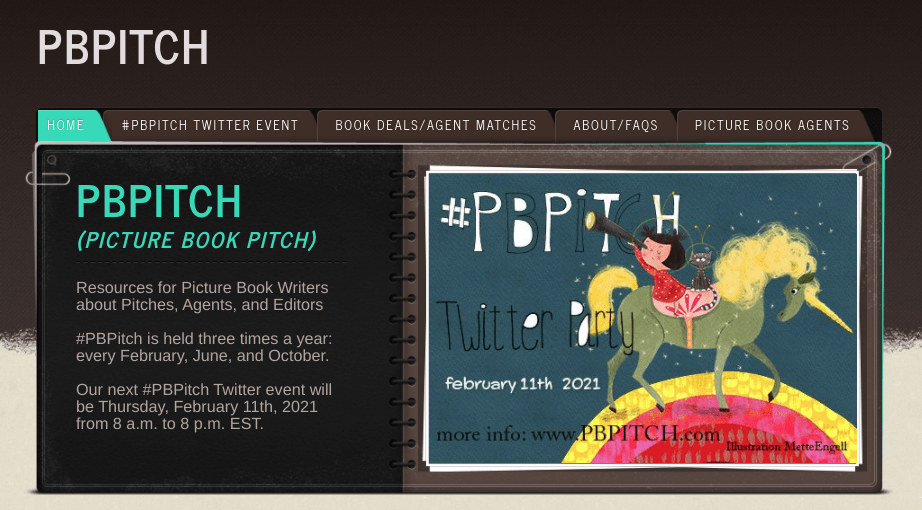
Then this happened:

And I really, really, really wanted to be a part of it. The catch – you can’t take part in a Twitter Picture Book Pitch, without, well – being on Twitter. 

So I signed up and thought to myself,  I could always have a go at this whole #PBPitch thing and if it’s a massive flop then I will just quietly sneak away and press ‘delete account’. No-one will ever have to know…

It’s been 24 hours and I am, of course, completely obsessed. It had never occurred to me how instantly the world of #childrensauthors would open up to me, with very little effort on my part. My homepage/thread/newsfeed (I’m not sure I’ve got at the Twitter-friendly vocab yet) is flooded with other children’s authors – ones like me, starting on their journeys, others who are publishing for the first time this year, right up to famous authors. 

I now have access to their tweets, their thoughts, their world. And it’s not just authors – I am also following literary agents and publishers and editors. Of course, it doesn’t actually make me any closer to being published but it makes me feel like I’m a little bit closer to the playground I want to play in. It’s a community of people who are interested in, and talking about, writing for children and that is a very exciting group of which to be a part. 

Of course, now I’m blogging about tweeting and tweeting about blogging – it would be very easy to get caught up in the moment and forget why I’m actually here. Between the tweets and the blog and the website and finding my feet on social media, I must remember to make time to actually be creative, to write. Despite my initial fears, I feel energised by this new-found platform, excited to share my ideas and find my wings in this new world. 

@CharlieBown7

The Chapter Book

I have loved writing picture books over the last year – they have proven themselves to be far more complex, exciting and demanding than one might believe of a story, especially one where so much is told through the illustrations and their interaction with the words. 

For now though my picture books are resting – taking a breather and enjoying some space away from my frantic editing and re-writes. I know that for as much as I love my stories we are too close now – like lovers who have spent time in a honeymoon bubble and need some time to step away from one another and remember who they are alone. 

We will reunite once more, perhaps in a few months, with fresh eyes and excitement. Now it’s time to try something new. Creativity does not come from reading and re-reading the same words. It comes from challenging yourself with new ideas, new words and new experiences. From looking at something different and asking questions you haven’t asked yet.

I am currently working on my first chapter book for 7-9 year olds. Just learning this information has taken a disproportionate amount of time in my mind. It transpires that chapter books for children are categorised under two headings – early readers and middle grade. Afterwards you’re moving into Young Adult stories which I’m not grown up enough to write yet. Seems simple enough? Except then you learn that there are different age brackets within early readers and not all agents, publishers or book sellers categorise them in the same way. Mind-Blown. 

If the age range debacle wasn’t enough to get your head around, the gender division within the marketing world of chapter books has left me awake at night with fury. Chapter books – think the Beast Quest series aimed at boys and the Rainbow Magic series aimed at girls. Scary monsters and adventure for boys, fairies and sparkly rainbows for girls. I’m deliberately choosing extreme examples and of course there are a wealth of books which don’t rely on these specific gender extremes but the books are still labelled ‘boy books’ and ‘girl books’ – blue and pink. 

Interestingly, research shows – and this is certainly true of my experience teaching and reading with this age group – that girls will read books aimed at boys but boys are very unlikely to pick up a chapter book marketed for girls. So much so that to find a female lead character in a chapter book aimed at boys is a bit like meeting Santa, whilst cruising through the Bermuda Triangle on the back of a unicorn. 

Would Harry Potter have been as successful as it was if Hermione had been the hero and not the sidekick? Would boys have read that book? Would half of the population have missed out on the awesomeness of Hogwarts because there was a girl in the centre of the front cover?

These are the questions which have kept me awake at night. Looking back at my picture books I realised that Percy, Rufus, The skateboarding Baby, Croc and in fact all of my main characters are male. How did that happen without me realising? Me, who sings of empowering women and the importance of gender equality, how did I miss it? 

Even picture books are gender biased – I’ve read so many picture books with male characters that my brain is on male-character-auto-pilot. Enough is enough. 

I want our daughter (and perhaps even more importantly our son) to grow up reading my books which have amazing, strong, inspiring, awesome characters. I want them to be moved and excited and intrigued. I want them to love my lead characters as much as I do and I want them to see the character first and the gender second. 

Not much of an ask for my first chapter book series then, is it?

Website Why?

After reading several articles which declared that all writers should have a website – whether published or not – I decided to take the great plunge into the vast ocean where dot.com dreams come true.

So I followed the WordPress step by step guide and, with an ease which surprised my technophobic brain, made a website and launched my ship.

Except now that I’m out here my cruise ship feels worryingly like some bits of old 2×4 tied together with fraying rope, floating around with no clear direction. So why exactly did I make this website? A sudden burst of imposter syndrome struck as I logged onto it for the hundredth time to read the content I had already committed to memory.

So I messaged two friends. The first a self-taught photographer who reminded me that if you are good at what you do then you are good at what you do, and that half the battle is believing that you are good enough.

Still, those self doubts creep in and fester like woodworm, burying themselves into an already rickety vessel. What if I’ve made a website to promote myself as a writer but I’m not actually a good writer?

Rejection letters from publishers and literary agents line the back of my mind and whisper ‘character building’ and ‘give up’ in equal measure. And now I have a website but to what end?

The second friend I messaged worked in publishing, commissioning books and promoting authors before taking a career break when she became a mother. Her take on a website? Not as important as my research suggested. So why have one?

I expect it would have been helpful to work out why I wanted a website before I started sailing but as usual I have jumped in before checking the water. So here I am, floating along and wondering why. Here are my conclusions:

The Destination – to be a published writer. I don’t believe having a website will do that. I believe writing a good book will lead there and, as my friends reminded me, self belief and a little bit of luck.

The Journey – I know I work best when I feel accountable to someone or something. Right now I feel more determined to write more, write well and justify to myself that having an author’s website was worthwhile.

So this website is my sail, my oars and my helm. It’s going to keep me focused on the destination and enjoying the journey. I don’t think I will magically arrive at Destination Published by getting on the boat but I know that being on the boat is better than standing on the shore.

Are we born poets?

When children start talking they generally begin with sounds, then words, then phrases. Slowly building up to the mighty sentence. Often when they start, the words they attempt are mere representations of themselves and I am sure that parents, aunts, uncles, older siblings and grandparents amongst us can remember funny or unusual attempts at language that smaller people around them have made. 

Were it not for gestures and a particular pair of socks it would have taken us much longer to decipher that the word ‘Zu-Zu-Zaw’ in our two year old’s newly forming repertoire was in fact the embryonic stages of what would later grow and become, ‘Dinosaur’. 

As teachers, my husband and I are great champions of learning and the power of communication. Indeed we both delighted when our son was able to say the word Dinosaur and share with us what he wanted us to know. 

Yet Zu-Zu-Zaw sounds like a much more interesting prospect for a story or a poem. Where is the Zu-Zu-Zaw now? Banished and replaced with a dictionary approved and widely recognised noun.

I recently read an article about four year old Nadim Shamma-Sourgen whose poetry is being published next year after it was posted on Twitter and caught a net full of hearts and minds. He writes as a child should and can write – with innocence and yet astounding depth of feeling and knowledge, which children acquire so quickly whilst learning about the world around them. 

All children are poets because they do not know of, or care for, literary restraints and linguistic taboos. They are free from the knowledge of a correctly constructed and punctuated sentence. These things are, of course, important in written communication. There is an argument that we must have the ground work in place, the foundations of structured language, which enable us to then start breaking it down, moving it around and playing with its form and tone to create a poem. 

Yet children learning to speak seem to skip this vital step and speak firstly in poetry. 

The other day our three year old declared he couldn’t get ready for bed. When asked why he announced, “Because I haven’t got a yawn.” Something an adult would never say. What would we say in its place? ‘I’m not tired?’ – It hardly sings as a response does it? Because poetry should sing, it should dance across the page and flow and ebb like music. 

Whether they are possessed with natural talent as singers or not, very little stops children from blasting out a song they like or making up songs to tunelessly repeat. Often the first experience children have of written texts is stories in verse, nursery rhymes or nonsense poems. Is it any surprise then, that with a diet of delights such as Dr Seuss, the confidence of professional singers and the lack of structure in their language, that children are the natural poets of our world?

The greatest children’s poets and writers have the ability to capture the essence of childhood and the voice of a child. They are silly and playful and creative with language and allow themselves to boldly declare they are singers and artists. They throw caution to the proverbial grammatically correct sentence and they let their words dance across the page. Most excitingly, they are not afraid to use words which no-one else knows yet. 

Let the Zu-Zu-Zaw be extinct no-more – it’s time to hear her roar.