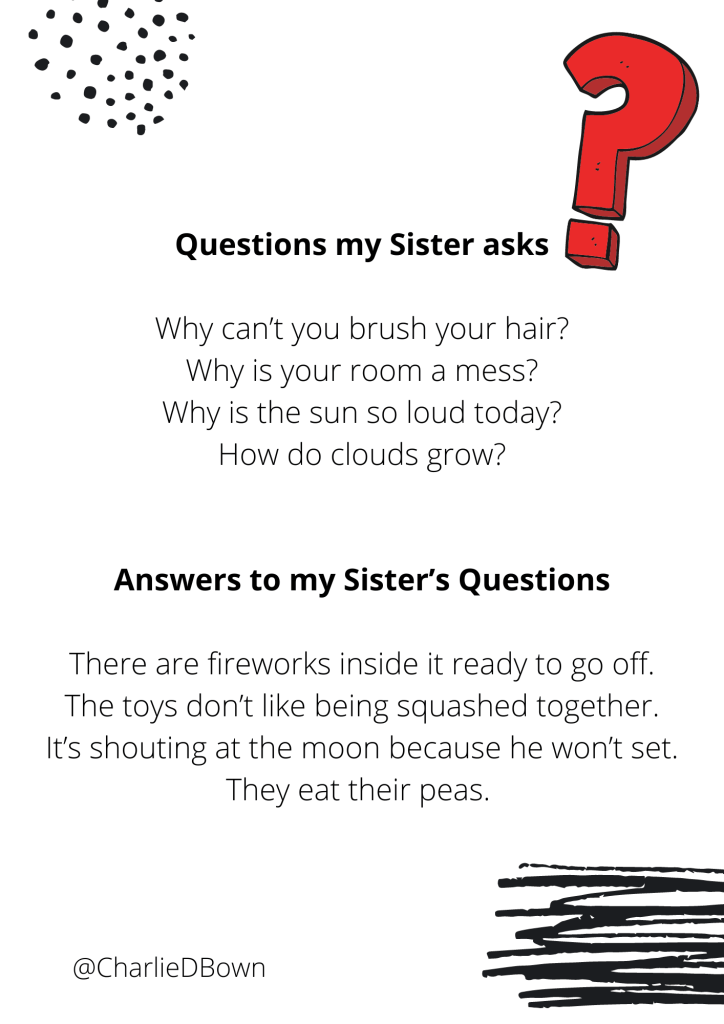
Question and Answer poems are so much fun to write! You don’t have to separate out the questions and answers like I have – they can follow one another like a conversation.
If I asked you, “What’s your favourite colour?” you might answer ‘Red’ or ‘Green’. Try answering that question again with your poet hat on.
What’s your favourite colour? It’s the forests and valleys. The grass beneath my toes. It’s a strawberry fresh for picking. The moon, blood-angry with the sun.
Have a go at writing some question and answer poetry. You can use these question prompts to get you started.
Where does the sun go at night? How far away is the moon? Why does the morning bird sing? Where is the missing sock?
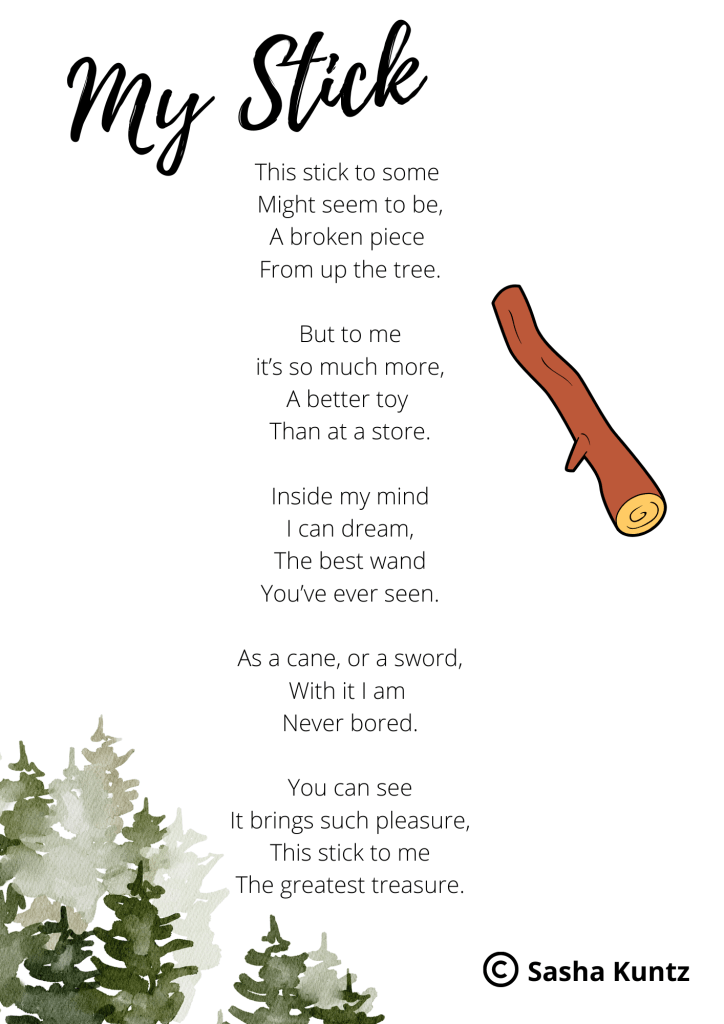
Today is a little bit different because instead of one of my poems, I am sharing writing from another author who has been in touch. I am delighted to share Sasha’s poem, ‘My Stick’, which was inspired by the ‘Treasure’ prompt from my Day 7 post.
One of the wonderful things I’ve noticed since reaching out to the writing community via Facebook and Twitter, is how wonderfully supportive they are of one another. It is certainly one of the happier parts of the internet and it is a pleasure to pass on some of that writing support to another poet today.
It can be really scary to share your writing with people, especially a stranger! So thank you to Sasha for getting in touch and for your fab poem:
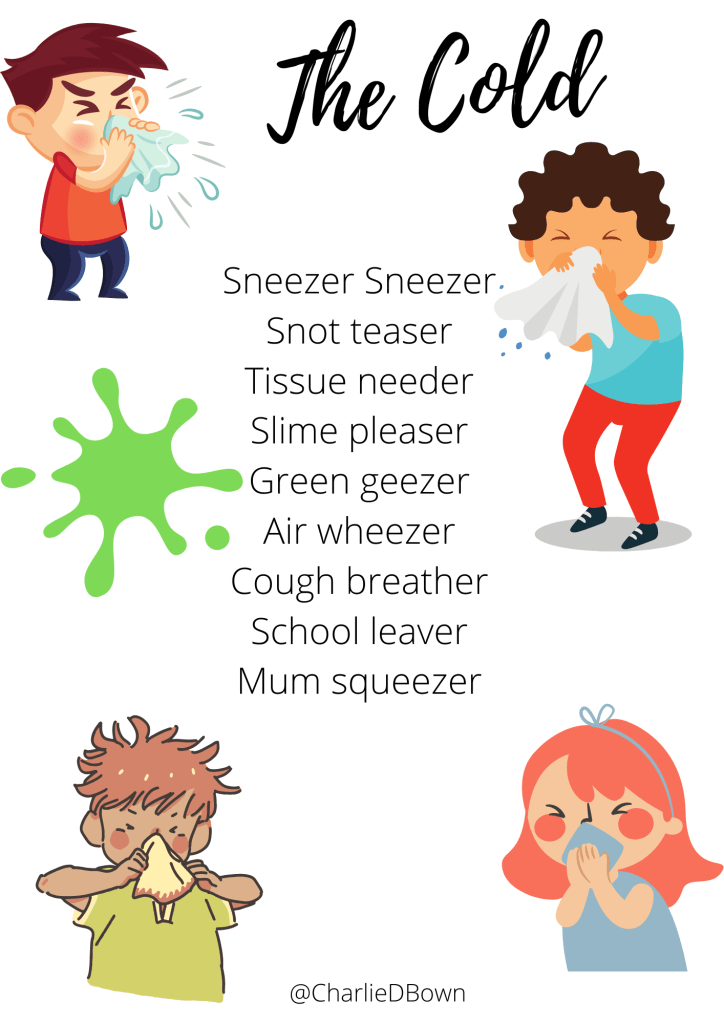
I wrote this poem when our son misheard the word ‘earache’ and refused to believe me when I said it wasn’t ‘earwig’. Combined with his mispronunciation of the word ‘antibiotics’ it was a poem waiting to happen.
(It’s also true that my mum used to say that we should wear our hats to avoid earache – I have no idea if that is medically sound advice, or just something parents say – like watching too much television makes your eyes go square.)
Children often mispronounce words. Did you mispronounce any when you were younger? My little brother said ‘Heliplopter’ instead of ‘Helicopter’ which we like to remind him sometimes now he’s a grown up doing grown up things.
One of the things I love about writing children’s poetry is the fun that is to be found when playing with words and language. Children do this naturally as they are learning to speak. Have a go at writing a poem with some mispronounced or misused words and see what you can come up with.
Remember, you can always email me any poems – I’d love to see them and share them on here!
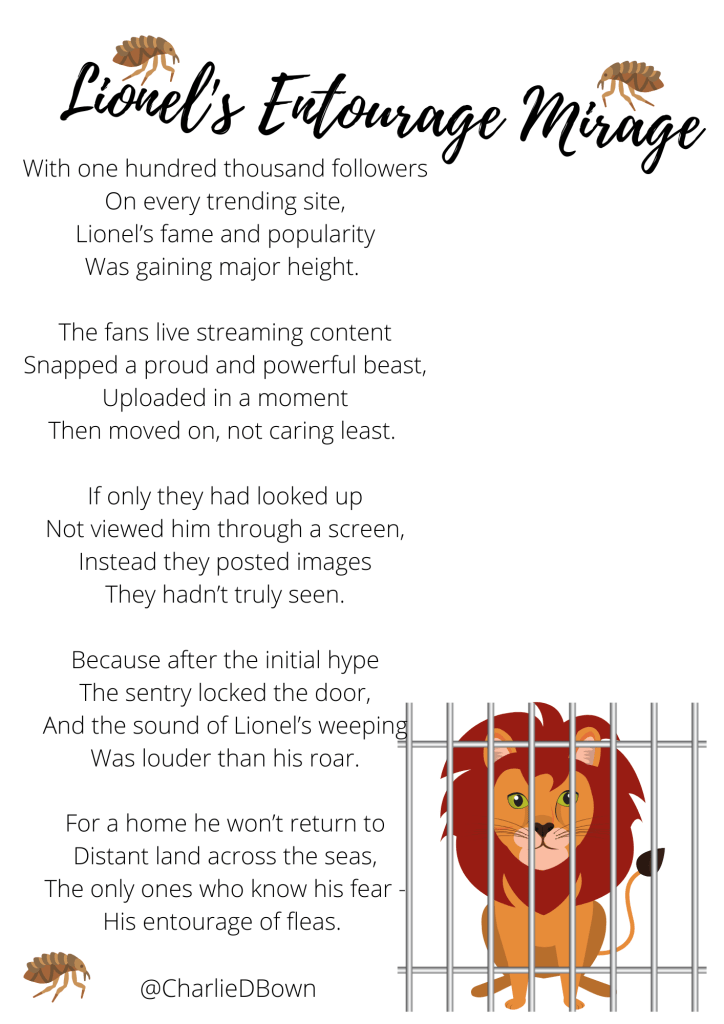
I wrote this poem as part of a competition, using a word prompt. The word I was given was ‘entourage’.
The first thing I did was read a definition of the word:
ENTOURAGE noun
a group of people attending or surrounding an important person. “an entourage of loyal courtiers”
Then I created a mind-map around the definition, taking each part in turn.
‘A group of people’ – what if they weren’t people? Who else might they be?
‘surrounding’ – for what reason? Could it be sinister? Funny? How close could they get?
‘an important person’ – Why is the person (or animal) important? Are they only important to the entourage?
I then thought about what entourage meant to me. It meant celebrity culture – adoring fans surrounding a popular singer or actor.
All these questions and thoughts helped me get to the stage where I had the idea for this poem.
‘A group of people’ (fleas) ‘surrounding’ (living on) ‘an important person’ (Lionel). Poor Lionel, who has adoring fans by day who take photos and upload them to social media, but is left alone at night with his real entourage – his fleas.
A writing prompt can be a fun way into a poem – especially if you take the time to really think about all the different ways that word could be interpreted. Have a go with one of the following words:
I loved writing this poem and I really enjoy reading it with children. The ending always makes them laugh and it’s great fun to have two people read the poem as a conversation.
Have a go at writing a conversation poem. Who might be talking? Could it be a conversation between a parent and child – what if they swap traditional roles? Maybe the child could be telling the parent off for being silly… my son does this a lot to me!
What about a conversation poem between animals, or inanimate objects? Imagine what a pair of shoes or a bowl of fruit might have a conversation about – there is lots of fun to be had!
I wrote The Crocodile Lady whilst visiting a Crocodile farm (who knew they existed!) near our house. After looking at the crocodiles we went for a walk in the nearby forest and stumbled across a wooden hut. It was abandoned and almost hidden in greenery, but it caught our eye as we walked past.
I imagined who might live there if this was a story. The Crocodile Lady was born. I suppose it might also act as a cautionary tale – stranger danger and the old ‘don’t go with someone just because they offer you sweets’ phrase that parents parrot out to small children.
Many children enjoy reading and writing scary poems. Make a word bank of creepy, horrible words and then create a character to describe.
Perhaps you will choose a monster or a beast. But what would happen if you wrote a terrifying tale about a hamster or a bunny rabbit? Sometimes contrasting a character with traits you wouldn’t expect can be a lot a fun!
The Hideous Hedgehog or The Blood-Curdling Butterfly…
The Potion is a list poem. They are one of my favourite types of poem to read and write. This one was inspired by children’s bath time but they can be about absolutely anything!
Ian McMillan wrote one called ‘Ten Things Found in a Wizard’s Pocket’ and Colin West wrote one called ‘Socks’ – you should check it out – I bet you never knew there were so many types of sock!
Why not have a go at writing your own list poem? This can work well in the classroom as a starter activity with each child writing just one line to add to a shared poem.
How about ‘A List of Things I’ve Forgotten’ or ‘Times I’ve felt Scared’. You could write a poem called ‘Things I’d take to the Moon’ – I’d take some crackers to have with all that cheese.
For an extra challenge try using your list poem to tell a story – at the end of The Potion we can imagine bath time coming to an abrupt end. What will happen at the end of your poem?
I haven’t blogged for a while and, like most things, blogging is much easier when it becomes a habit. I habitually brush my teeth in the morning, drink tea with one sweetener and leave the house with all the children and paraphernalia with which they are associated. This is routine and so it gets done.
When I blogged for 100 days in a row about exercise it wasn’t a chore (nor, surprisingly, was the exercise!) but now my trainers are lost to the back of the downstairs cupboard along with a few broken toys and that coat I never really liked but pretended I did to be polite. My blogging momentum lies abandoned with them.
So I have set myself a challenge. Inspired by poet Brian Moses’ blog, found here, I have challenged myself to share a poem a day for the month of March, alongside some tips for how they might be used to inspire ideas for writing poetry. You can follow Brian Moses on twitter: @moses_brian
I wrote this poem after watching our children playing in a role play kitchen. They did not concern themselves with making the usual foods one might find on a cafe menu; they let their imaginations run wild!
Have a go at writing a food poem.
You could write a BOGUS BREAKFAST menu or a list of treats to be sold at the CEMETERY’S MIDNIGHT CAKE STALL – what would be on it?
Perhaps your poem will contrast delicious foods with grotesque descriptions – there is lots of fun to be had!
Think of unusual places food might be served. What about afternoon tea on the moon? What might be on the menu then?
If you want to share your poem with me I’d love to read it! You can email charliebownauthor@outlook.com or share your work via Twitter @CharlieDBown



 Charlie Bown