March 9th – Earwig

I wrote this poem when our son misheard the word ‘earache’ and refused to believe me when I said it wasn’t ‘earwig’. Combined with his mispronunciation of the word ‘antibiotics’ it was a poem waiting to happen.

(It’s also true that my mum used to say that we should wear our hats to avoid earache – I have no idea if that is medically sound advice, or just something parents say – like watching too much television makes your eyes go square.)

Children often mispronounce words. Did you mispronounce any when you were younger? My little brother said ‘Heliplopter’ instead of ‘Helicopter’ which we like to remind him sometimes now he’s a grown up doing grown up things.

One of the things I love about writing children’s poetry is the fun that is to be found when playing with words and language. Children do this naturally as they are learning to speak. Have a go at writing a poem with some mispronounced or misused words and see what you can come up with.

Remember, you can always email me any poems – I’d love to see them and share them on here!

charliebownauthor@outlook.com

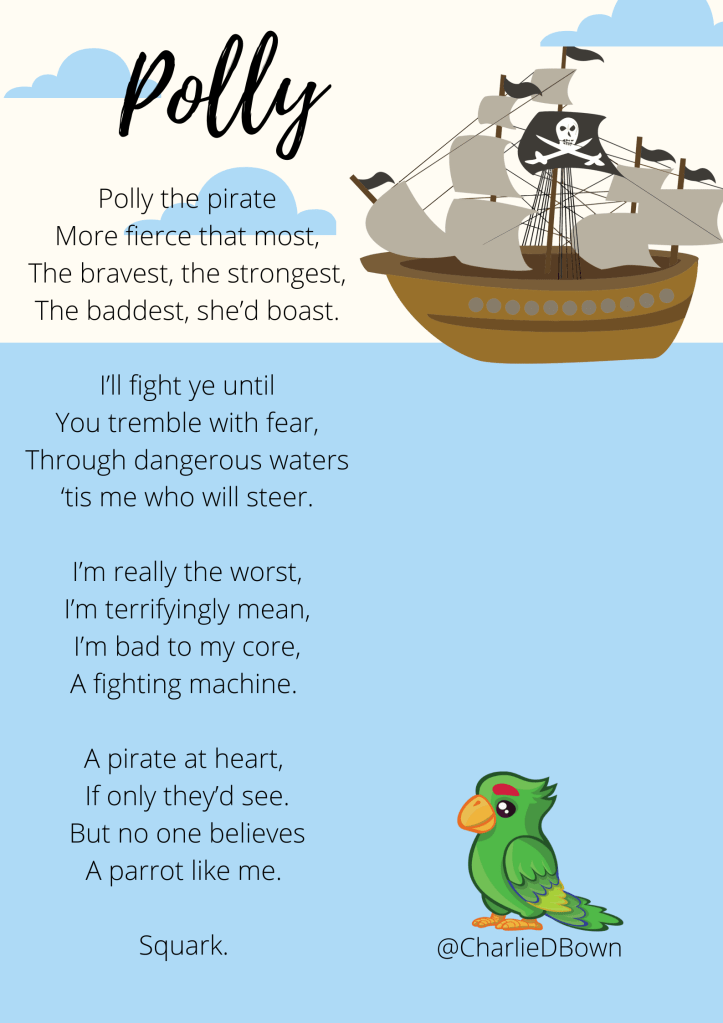
March 8th – Polly

I wrote this poem for my son’s class as this year they celebrated World Book Day as pirates.

I remembered reading some advice a while ago about writing poems. It said that there are lots of poems about pirates (and that’s true!) – so how do you make yours different?

One way to do that is to think about the traditional traits associated with pirates and then turn them on their head. What would a poem about a worried or nervous pirate be like? Perhaps you could write one about a pirate who rescues people, instead of threatening them. Taking a character stereotype and reversing it is great fun to explore with poetry.

I wanted the surprise in my poem to come at the end – when we hear that the pirate is actually the ship’s parrot. But you might reveal your surprise earlier.

Have a go at writing a poem about a character with a surprising twist. Perhaps a Dinosaur who is really good at saving people (instead of eating them!) or a fairy who likes to bring bad luck, instead of making wishes come true. Have fun!

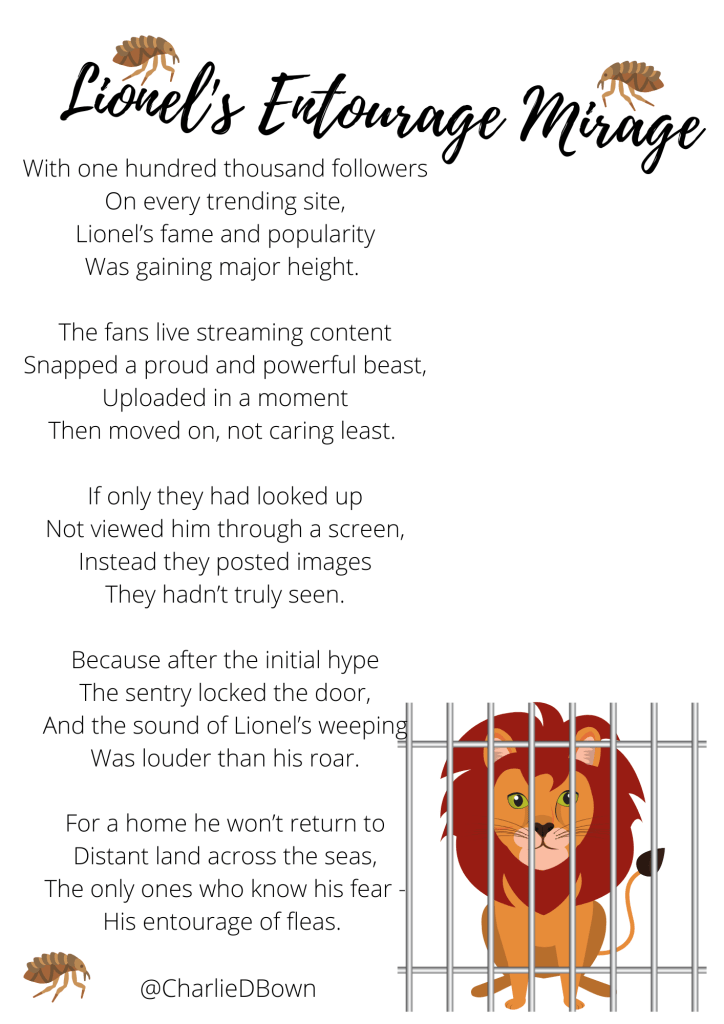
March 7th – Lionel’s Entourage Mirage

I wrote this poem as part of a competition, using a word prompt. The word I was given was ‘entourage’.

The first thing I did was read a definition of the word:

ENTOURAGE
noun

  1. a group of people attending or surrounding an important person. “an entourage of loyal courtiers”

Then I created a mind-map around the definition, taking each part in turn.

‘A group of people’ – what if they weren’t people? Who else might they be?

‘surrounding’ – for what reason? Could it be sinister? Funny? How close could they get?

‘an important person’ – Why is the person (or animal) important? Are they only important to the entourage?

I then thought about what entourage meant to me. It meant celebrity culture – adoring fans surrounding a popular singer or actor.

All these questions and thoughts helped me get to the stage where I had the idea for this poem.

‘A group of people’ (fleas) ‘surrounding’ (living on) ‘an important person’ (Lionel). Poor Lionel, who has adoring fans by day who take photos and upload them to social media, but is left alone at night with his real entourage – his fleas.

A writing prompt can be a fun way into a poem – especially if you take the time to really think about all the different ways that word could be interpreted. Have a go with one of the following words:

adopted

treasure

disaster

March 5th – Boys Can’t Be A Princess

I loved writing this poem and I really enjoy reading it with children. The ending always makes them laugh and it’s great fun to have two people read the poem as a conversation.

Have a go at writing a conversation poem. Who might be talking? Could it be a conversation between a parent and child – what if they swap traditional roles? Maybe the child could be telling the parent off for being silly… my son does this a lot to me!

What about a conversation poem between animals, or inanimate objects? Imagine what a pair of shoes or a bowl of fruit might have a conversation about – there is lots of fun to be had!

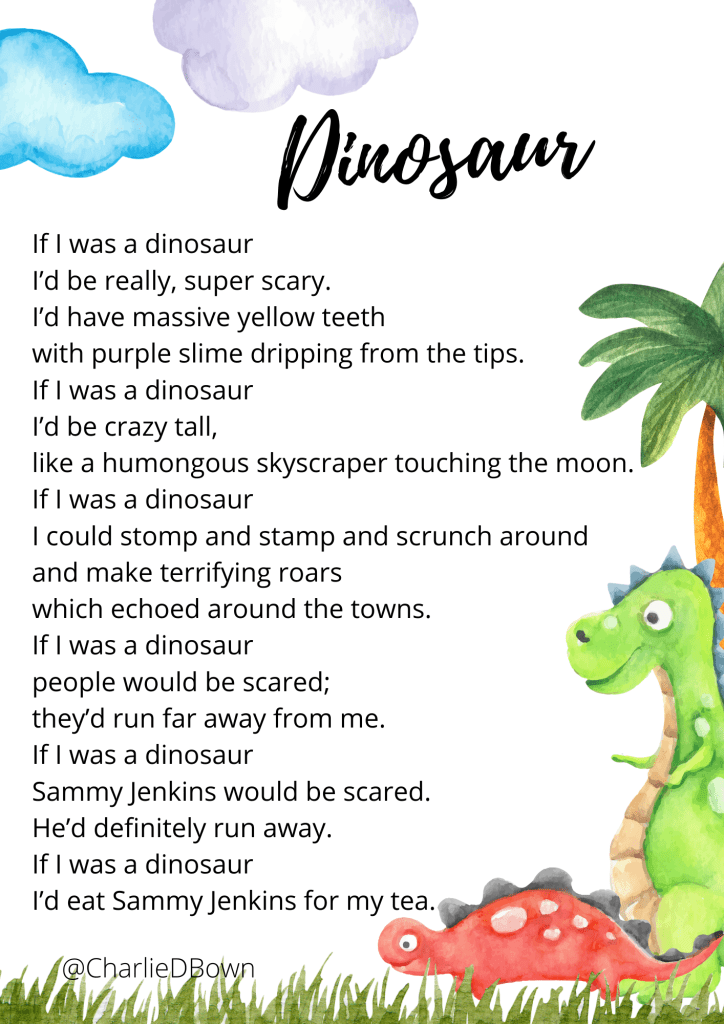
March 4th – Dinosaur

Depending on how confident children feel with drama activities, this activity can be done in a group or as individuals.

If working in a group ask children to choose an animal – living, extinct or fictional. Working together they have to create the animal using their bodies, working together to move around the space. Once they feel confident moving as a team encourage them to add sound effects, then give them different challenges to act out. How would your animal eat? Sleep? Interact with other animals in the room?

Once you’ve had fun exploring the animals, create word banks using the drama to guide you. To extend the activity think about what the animal might represent (Lions = bravery, Foxes = sly etc) can you add those characteristics into the poem? What happens if you reverse them – write a poem about a shy lion or a kind fox.

Use “If I were a…” as the poem’s starting prompt.

March 3rd – The Crocodile Lady

I wrote The Crocodile Lady whilst visiting a Crocodile farm (who knew they existed!) near our house. After looking at the crocodiles we went for a walk in the nearby forest and stumbled across a wooden hut. It was abandoned and almost hidden in greenery, but it caught our eye as we walked past.

I imagined who might live there if this was a story. The Crocodile Lady was born. I suppose it might also act as a cautionary tale – stranger danger and the old ‘don’t go with someone just because they offer you sweets’ phrase that parents parrot out to small children.

Many children enjoy reading and writing scary poems. Make a word bank of creepy, horrible words and then create a character to describe.

Perhaps you will choose a monster or a beast. But what would happen if you wrote a terrifying tale about a hamster or a bunny rabbit? Sometimes contrasting a character with traits you wouldn’t expect can be a lot a fun!

The Hideous Hedgehog or The Blood-Curdling Butterfly…

March 2nd – The Potion

The Potion is a list poem. They are one of my favourite types of poem to read and write. This one was inspired by children’s bath time but they can be about absolutely anything!

Ian McMillan wrote one called ‘Ten Things Found in a Wizard’s Pocket’ and Colin West wrote one called ‘Socks’ – you should check it out – I bet you never knew there were so many types of sock!

Why not have a go at writing your own list poem? This can work well in the classroom as a starter activity with each child writing just one line to add to a shared poem.

How about ‘A List of Things I’ve Forgotten’ or ‘Times I’ve felt Scared’. You could write a poem called ‘Things I’d take to the Moon’ – I’d take some crackers to have with all that cheese.

For an extra challenge try using your list poem to tell a story – at the end of The Potion we can imagine bath time coming to an abrupt end. What will happen at the end of your poem?

March 1st – The Menu

I haven’t blogged for a while and, like most things, blogging is much easier when it becomes a habit. I habitually brush my teeth in the morning, drink tea with one sweetener and leave the house with all the children and paraphernalia with which they are associated. This is routine and so it gets done.

When I blogged for 100 days in a row about exercise it wasn’t a chore (nor, surprisingly, was the exercise!) but now my trainers are lost to the back of the downstairs cupboard along with a few broken toys and that coat I never really liked but pretended I did to be polite. My blogging momentum lies abandoned with them.

So I have set myself a challenge. Inspired by poet Brian Moses’ blog, found here, I have challenged myself to share a poem a day for the month of March, alongside some tips for how they might be used to inspire ideas for writing poetry. You can follow Brian Moses on twitter: @moses_brian

I wrote this poem after watching our children playing in a role play kitchen. They did not concern themselves with making the usual foods one might find on a cafe menu; they let their imaginations run wild!

Have a go at writing a food poem.

You could write a BOGUS BREAKFAST menu or a list of treats to be sold at the CEMETERY’S MIDNIGHT CAKE STALL – what would be on it?

Perhaps your poem will contrast delicious foods with grotesque descriptions – there is lots of fun to be had!

Think of unusual places food might be served. What about afternoon tea on the moon? What might be on the menu then?

If you want to share your poem with me I’d love to read it! You can email charliebownauthor@outlook.com or share your work via Twitter @CharlieDBown

Coming Soon!

When I started approaching agents and publishers last year I was prepared for the inevitable rejection emails. Everything I’d read about this process suggested it could (and most likely would) be a long journey to publication, if I ever got there at all.

So why not self publish?

When I decided to be a teacher I didn’t just rock up to a classroom and get on with it. I spent a year training and completed a PGCE, had my lessons observed and commented on, learnt what I was good at and what I needed to work on. I had a tutor and a mentor and by the end of the year I knew I was going to be good at my job.

How do I achieve the same validation within the world of writing? To me the answer seemed simple, find an expert in the industry and get them to love my books. I am not against self publishing at all and I have read lots of SP books which I’ve loved. But for me, I needed the reassurance that a professional in the industry agrees that my writing is worthy of being put into a book.

I still do need that external input. So for now my picture books and chapter books remain firmly unpublished and waiting for that magic agent or spectacular rewrite when I come back to them again later. But poetry, it turns out, is a different sort of ballgame.

So many agents and publishers have NO POETRY on their submissions guidelines. Why? Kids love poems! But this is a business game after all and a little poetry book by an unknown poet is not necessarily going to equal big sales numbers. When it comes to poetry there seems to be a much bigger no entry sign than any other type of text.

Three things have happened in the last few months.

Firstly, a friend in the music industry told me that when people approach him with songs the first thing he wants to know is who is this person and how committed are they? Is it one song or do they have more? The bottom line – why should he take the risk? Finally, he asked me if I had considered self publishing my poetry to show I’m committed to my own writing?

No. No, I hadn’t.

The second thing that happened was that I contacted a published poet. Someone relatively new in the industry, someone whose poems I’d read and enjoyed, someone who was where I wanted to be – visiting schools with his published poetry books and sharing them with children.

Do you have an agent? How did you get published? Please tell me your secrets!

He explained that his journey started as a self published poet. Once he’d spent a few years doing the school circuits and selling his books he approached a publisher and said, hey – look at me! I’m great at this. And he could prove it. He was selling books and that was a language the publisher was willing to take a chance on.

The third thing that happened is that it was National Poetry Day and I felt really sad. I felt sad that for another year I was looking at my poems in a file on my computer and wishing rather than doing. The theme of NPD this year was choice.

OK, Universe. You have my attention.

Because we do have a choice. A choice authors in the past didn’t have and perhaps that choice is also a chance, a chance to prove that you’re passionate and committed and most importantly, excited to share your writing with an audience.

And on that note, I hope to have some very exciting news to share with you soon…